From ‘The Giver’ to ‘The Roosevelts,’ HOPE


I can’t remember which book I read first, Lois Lowry’s “The Giver” or Barbara Kingsolver’s “The Handmaid’s Tale.” It was only a couple of years ago, but what I do remember is feeling hopeless.

If that was how those books made me feel, why read more? Admittedly, I can be a little dense and it would take several more brushes with dystopian literature before I’d grasp the meaning of such a category.

There was the buzz over “The Hunger Games” trilogy by Suzanne Collins. With the first movie set for release in 2012, I read all three before. Then there was Veronica Roth’s “Divergent” series.

Fortunately my mom, aunts and cousins formed a book club before I could read Roth, thus steering me away from such bummer reads. That, and the ridiculously addictive “50 Shades” was released that same year.

But eventually I found myself back in the future, watching the big screen version of Orson Scott Card’s “Ender’s Game” and reading Edan Lepucki’s “California” this summer.

As mentioned, I can be a little simple and while I’d heard the word “dystopian” thrown about, it didn’t dawn on me that this was the category of literature I’d been consuming until this summer when muscling through Lepucki’s debut tome about life after the collapse of the U.S. government.

My husband asked me what it meant, dystopian literature. I said, “Think the opposite of ‘utopia.’”

I’m not sure what came first, my current episode of depression or reading this depressing genre, but they certainly haven’t helped one another.

I guess I shouldn’t have been surprised when a close friend recently asked me to stop reading dystopian literature, “at least for the rest of the year.”

She should’ve included movies in that plea as my daughter and I saw “The Giver” over the weekend.

I’ve heard some fans of the book argue the movie did not follow the story as much as they’d hoped. Myself, I didn’t like the movie (or the book) because it’s so dang depressing!

My critics would argue all these books and movies end on hope-full notes, that the characters realize the err in such a life and seek change for the better. I, however, get snagged on the society those characters are pushing against—how did it get that way?!

With “The Giver,” life has been sterilized against all emotion, all choice in exchange for an easily controlled, peaceful society. Daily medication is administered to everyone in an effort to keep the senses dulled and the mind clouded.

But when the lead character, Jonas, nears graduation, he begins to glimpse moments of color. At graduation, when teens are assigned their careers, Jonas learns he’s going to be trained as a “Receiver” and in meeting with the “Giver” (played by Jeff Bridges) Jonas starts to question everything.

As memories of the human race are transmitted from the Giver to the Receiver, Jonas begins to understand society has been robbed of all the freedoms that make us human—freedom to feel, freedom to see, freedom to sense.

The book version ends with Lowry leaving the reader to decide what happens to Jonas. The movie chooses a more definitive, happier ending. Both endings left me sad.

How does a society implode in such a way that results in having all choice removed?!

I’d like to imagine we’re far from such a dystopia, but we’re not. Look at the state of our nation.

Our government doesn’t work. Our nation remains hung up on skin color and gender. Our Supreme Court ruled money talks. Our middle class is dying from stagnant wages, rising costs and an unfair tax code. Our manufacturing was exported. Our jobs were out-sourced. And the only people benefitting from America’s current way of life is our elite class, the 1 percenters.

To me, it feels as if our country is barreling towards an abyss from which we’ll never recover, so thick is the hatred and greed.

But then came Ken Burns. This amazing film maker has released yet another series, the seven-day “The Roosevelts: An Intimate History” on public television, which concludes tonight.

I find hope in Burns refusing to let history be forgotten, in his innate ability to show people the similarities between their then and our now.

With “The Roosevelts,” Burns is able to show how important it is for government to intercede when the “ruling class” refuses.

From this early 20th century era, our country saw positive change come to the working poor with improvements made in wages, working conditions and hours. Women gained the right to vote. Monopolies and trusts were destroyed.

What happened? Several decades of “can-do” Americanism, though some will try to argue this impetus.

I take heart in knowing others have been watching “The Roosevelts” and will acknowledge its parallels to today’s weakened America. My hope is still others will begin to recognize the lies some media are selling them, will grasp the necessity for helping the less fortunate, will see that 99 percent of us are held hostage by the ruling class.

My main hope, however, is that people will open their eyes and ears and hearts to understand that the society in which we live is broken. But, most importantly, that we can do better and thus avoid a dystopian reality.


Originally published 20 September 2014 in The Observer.

Adventures in lawn care & life north of Hwy 136


Just so you know, I kind of love mowing lawn. It harkens back to those pre-teen years when cousin Laura (Olson) Wallace and I would spend hours and HOURS grooming Gramma Olson’s expansive front lawn, orchard and sprawling east yard that doubled as a baseball field.

More than a job or task to sweat through, mowing Gramma’s grass offered a sense of pride. The clean lines. The level grass. The smooth results. Could there be a more visual example of the term: perfect?

Like a spotless kitchen, a clothesline filled with laundry or a re-organized desk, the feeling of order—albeit brief—is one of the best feelings I know!

And it’s in the grass, a perfectly coiffed lawn, where I find my greater peace . . . or at least I did.

For the first chunk of Marty and my marriage, we were “townies” living in DeWitt, Iowa, and the mowing of our corner lot was his domain. I was used to caring for big spaces with big lawns, not small, fenced-in plots of grass.

A phrase like “clipping the lawn” sounds cute and suggests a job that requires minutes, which is how long it took Marty when we lived in town. A cool 45-minutes of sauntering behind a push mower and that was that.

So when we left town and took over the old Joe Brown place, I was stoked at the idea of having a big lawn. What I wasn’t prepared for was how unruly that lawn would be!

Initially I envisioned using our push mower on the three mow’able acres that made up our four acre parcel. I saw my legs getting buff, my arms, toned, but then reality hit me. We needed a riding lawnmower and went with what we could afford, a hand-me-down freebee from Dad Reed.

That old John Deere lasted a few passes before chugging to its death, mid-job. It didn’t even make it to the end of the season. And because we lacked the necessary moving equipment, the poor thing sat in our front yard for a couple of weeks while grass grew up around it.

If Joe Brown’s spirit still hangs about our farmette, I’d like to think he and his late wife Marge find our efforts to tame their wild land humorous. I’d hate to think he’s put a curse on us.

But when you consider our history with lawnmowers, it’s hard to think otherwise. Joe Brown’s has shown to have the exemplary talent for weed growth and lawnmower extermination.

To date, Joe Brown’s has killed not one, but TWO old John Deere mowers, our once-new push mower as well as a new Poulan. And our current used Sears Craftsman looks as if it won a lawnmower demolition derby (and mows like it, too).

The serenity I used to find in mowing my parents’ and grandmother’s yards has yet to be found at Casa Reed Murrell. Who knew you could actually take smooth ground for granted, but you can. I did. Having grown up along Hwy. 30, between Calamus and Grand Mound, the ground is flat and the lawns have a near fairway-like quality.

After nine years of working to make Joe Brown’s ground behave, fighting with it to smooth itself out, Joe Brown’s ghost has been laughing his tail off.

The early years were fraught with spring thaws that would have the lawn heaving various forms of detritus: glass and bricks, car door handles and lug nuts, batteries and hub caps. The first mows of the season were very much like Forrest Gump’s box of chocolates.

You’d think I’d get used to the loud bang that results from running the mower over these objects, but when the blades find an old wrench and send it banging around the undercarriage and out the side, that’s a sound (and feeling) from which you don’t quickly recover.

And then there were the imaginations of our children when at ages three and six, Maclane and Moira, would take large rocks and make “dinosaur nests.” The kids, especially Maclane, were huge into dinosaurs and one day they hatched the brilliant idea of pretending the decorative river rock around the house were dinosaur eggs. They’d take these rock “eggs” and build nests throughout the yard. Sometimes at the base of trees, other times, out in the middle, blanketed by grass “so they’d stay warm.”

Imagine, bouncing along (there’s no smooth rolling), focusing on how grateful you are that the machine was actually working, only to have one’s reverie harshly interrupted by the horrific sound of large river rock being chewed up by your already-ailing lawnmower?

Nope. Not fun.

Along with this, let’s not forget the oodles of trees Marty’s planted every year. Adding to the handful of young firs already established, he’s added countless variety of trees and bushes. Between the trees already here, the stumps of trees lost and the ones Marty and the kids planted, we have exactly 95 trees (and two stumps) around which we now mow.

It’s a job requiring much patience, many hours and lots of “Marty” since he’s the only one who can get the Craftsman mower to start.

Just as I’d begun to think I would never again experience the Zen-like satisfaction of a day’s worth of lawn work, I went and got myself an early birthday present!

For the last year I’ve been sniffing around for a new (or newer) mower. But it couldn’t be just some ordinary rider, Joe Brown’s was proving to be a wily foe. It was time we got serious and until recently, it was an expense I simply couldn’t justify.

The Pat Howell quote: “Grass is the cheapest plant to install and the most expensive to maintain,” couldn’t be more true.

Tune in next week for adventures in zero-turn mowing . . .


Originally published 6 September 2014 in The Observer.

Lady Justice descends on serial-killer lawn


So I love mowing lawn, right? Well, I did . . . back in the day, when still a minor living at home.

The smooth, evenly cut grass of my Gramma Olson’s big yard was a thing to behold. Sure my lines could get a little crooked, especially when ground squirrels whizzed by, diving for their burrow right in front of my mower. But her lawn was flat, the grass was smooth and all felt right with the world.

I thought every lawn was like this. How naïve.

Tnew mowerhe nearly three acres that make up the mow’able portion of our Joe Brown farmette are anything but flat. And smooth? Hardly. Though fitting, given Joe Brown’s used to be a horse ranch, I didn’t think it possible to get saddle sores from mowing. You can.

Our “lawn” is made up of several areas: the front yard, the back yard, the yard in front of the corn crib and the yard behind the corn crib. I’d estimate the only flat, smooth portion is a 10-foot by 40-foot plot northwest of the house. The rest is a mine field.

Hindsight being what it is, I shouldn’t be surprised the four ordinary lawn mowers we’ve operated over the last nine summers would simply falter when faced with the monumental task of taming the beast that is the Joe Brown yard.

I never knew Joe Brown, but am often regaled with wild tales of goats in the bath tub, horse kibble in the kitchen, engines in the dining room and assorted saddles and bits in the living room. I never tire of hearing how nutty and open-hearted he was, but shaping up the Joe Brown place is no small feat.

It was clear, as Marty endlessly toiled to sustain the life of our fourth mower, a used, beat-up Sears Craftsman, we could no longer get by with a common, ordinary machine.

And given Marty’s work schedule coupled with his involvement at the Rock Creek Eco Center, not to mention managing the Charlotte Little League and coaching both baseball and soccer, he was eager to rid himself of the chronic pain that is the maintenance of the Joe Brown yard.

Which leaves me . . . and my lack of education in the industrial arts.

For a year I’ve been nosing around at local dealers, perusing the Internet, eye-balling sale ads and basically looking for something to smack me alongside the head.

Not only did I have my brother, Matt Reed, on the hunt, but Mom and Dad Olson, as well. The hunt was fruitless or maybe I was just gutless, how could I not be?! Our Joe Brown yard had killed three mowers and the fourth was dying a slow, hard-to-watch death. This yard was a serial killer!

Depending on whether it was Marty or I doing the mowing, the job could take anywhere from four to six hours. After, of course, the battery sat on a charger for a couple of hours. And the result of all that labor? A crappy looking lawn.

By Labor Day weekend, after wasting Friday fighting to get the dang thing started and burdening Marty with the task after he got home from work, I snapped. We were either going to fork over the cash for an appropriate mower or buy a herd of goats.

With Dad Olson available to “window shop,” he and I went to G & H Mowers in Grand Mound, Iowa, where he showed me what he’d wanted to buy last spring before Mom went and bought a new house.

I can’t help but feel like Tim ‘The Tool Man’ Taylor when I speak of this beast: a 48” Simplicity Champion XT commercial zero-turn riding lawnmower. Arw arw arw!!!

G & H co-owner Dennis Galloway reviewed the specs, told me about the four-year warranty and what they offered for maintenance. I figured if it was good enough for Dad, it was good enough for us and by Tuesday afternoon they’d delivered it and schooled me on the wily ways of zero-turn mowing.

First, I’ve never felt like a bigger idiot than when making the first passes around the front lawn. It was an all hands, no feet operation. To move ahead, you pushed the hand levers forward. To slow down, you pulled them back. There was no cruise control and no foot break. When I went forward it was either like a snail or a rocket. Clearly this took more finesse than I expected. And straight line? How ‘bout squiggles?

The turning was pretty awesome, but the looking out for low-lying tree limbs was another thing. The Champion XT came with a roll bar that Dennis warned we would likely remove if we had a lot of trees. (Remember, we have 95. NINETY FIVE!)

After snapping a couple of limbs and almost getting thrown off by one particularly strong branch, I parked it and let Marty remove the bar.

I’ve since mowed one other time and I’m quite smitten with the machine. Our grass looks level, the mounds of hay-like clippings are decreasing and the time? The first mowing took 3.3 hours and the second, 2.9!

I think this is the beginning of a beautiful relationship.


Originally published 13 September 2014 in The Observer.

Where did it go? A summer recap


Where did summer go?

One minute I’m swatting away pesky gnats while watching my son play baseball, and the next I’m dodging lightning bolts while timing participants of last Saturday’s CharVegas Mud, Sweat & Tears obstacle race.

Where did summer go?!!!

mac at deep creek dashI didn’t think we were over-scheduled. Daughter Moira doesn’t play softball and I kept my races to a five-year low. And yet here we are, Labor Day Weekend, and I’m wondering where the last three months went.

I remember being 5-years-old and sitting outside with my mom. It must’ve been a late August afternoon when I said to her, “Summer went fast.” I remember it so vividly because it was one of the few times Mom agreed with me, adding, “They go quicker every year.”

From ‘hospital corners’ to hanging laundry, my mom has dealt us her share of “pearls” but this was one that’s stayed with me because she couldn’t have been more right. In the nearly 40 summers since she said that, it’s unbelievable how each year the months of June, July and August fly by with increasing speed.

Where did June go?

We planned for this month to be low-key given the oral bone graft surgery daughter Moira had in mid-May. We were prepared for six weeks of slow, but the surgery went so well with bone being harvested from the mouth vs. the hip, that it hardly caused a hitch in her giddy up.

While she wouldn’t be cleared to eat hard foods until late June or go biking or swimming until August, her tan legs are proof of the hours she spent peacefully swaying on a porch swing that her brother and I built and attached to the frame of their old swing set.

I think of those days and forget about the flurry that was June. Son Maclane’s baseball schedule and Marty’s second year as general manager of the Charlotte Little League made it feel like the Charlotte ball diamond was a second home.

More than once did I laud friends who had multiple children on multiple teams, doffing my cap at their seemingly relaxed ability to catch each game and hardly break a sweat. I could barely squeeze in a game or two of nephews Jacob and Nic Reemstma.

But June was more than post-op recovery and baseball, it was also when my parents left the homestead and moved into DeWitt, when I stepped up to the direct the annual Paul Skeffington Memorial Race while also training for my first QC sprint triathlon.

Mom and Dad’s move was arduous in both physical and emotional ways while the Skeff Race and QC Tri were intimidating learning experiences. Fortunately I had wonderful committee members willing to hold my hand and fabulous training partners who coached me along.

And then suddenly it was Independence Day.

Where did July go?

The 4th always hits me with a dose of melancholy as it seems to herald summer’s swan song. And given Mom and Dad’s move “to town,” our annual watching of the Grand Mound fireworks from their house was now a thing of the past. All of us let the holiday go without much fanfare.

Just when we was ready to breathe a relaxed sigh that baseball was over, we realized the county fair was mere weeks away and neither child had started their fair projects. Any post-baseball bliss was kicked away by oodles of stripping, painting, sanding and varnishing.

Add to this Marty’s brief visit to New Orleans for a work conference, my participation in a 70.3 Ironman, a running of the Bix and the four of us at a Chicago Cubs game, and our cats were the only ones enjoying any sort of downtime.

And then we were driving to Wisconsin!

Where did August go?

During the first week of August, we took ourselves off the grid (well, ok, there was wifi) for a week along the shores of Moose Lake in Wisconsin’s Northwoods.

We swam, I biked, we boated, they fished. I taught Maclane how to play Gin Rummy while Marty and Moira shared secrets around the campfire. We listened to the Loons, hoped to spot the otters and bears, but mostly did a lot of nothing. It was heavenly.

And then we came back and went immediately to the State Fair, and then Northeast and Central school districts started school, and then I headed off to participate on a 6-person Ragnar Great River relay covering 200 miles in 36 hours. I’d done it before, but the heat got to me and all I can say is I survived and we weren’t last.

And then there was last weekend’s Charlotte Days with the first CharVegas Mud, Sweat & Tears obstacle race, which Maclane and buddy Isaac Trenkamp (and his mom, Patti) all completed during Saturday morning’s booming thunderstorm. While the storms put a damper on the crowds, the clouds cleared for Sunday’s 3rd annual Deep Creek Dash squirt gun 5k that will fund scholarships for local would-be Little Leaguers in the 2015 season.

What a fitting cap to such a busy summer! Despite the storms on Saturday, the drenched and dirty participants were all smiles. And though our 5k race is small, hovering around 40 runners and walkers, this year had a “golly gee Beave” sort of joy to it.

I may be tired, but it certainly was a great summer.


Originally published 30 August 2014 in The Observer.

Accepting the ALS Ice Bucket Challenge


Last week while watching The Tonight Show with Jimmy Fallon, I watched as Jimmy along with his sidekick Steve Higgins and band The Roots as well as guest Rob Riggle complete the ALS Ice Bucket Challenge.

Within a week, ALS Ice Bucket Challenges had spread like a bad case of poison ivy. Definitely for a good cause, though I was hoping this recent fad would remain a part of the celebrity ether.

What the challenge does is raise money and awareness of ALS (amyotrophic lateral sclerosis) and the ALS Association. More commonly known as Lou Gehrig’s Disease, ALS is a progressive neurodegenerative disease that effects nerve cells in the brain and spinal cord.

According to the ALS Association’s website, “When the motor neurons die, the ability of the brain to initiate and control muscle movement is lost. With voluntary muscle action progressively affected, patients in the later stages of the disease may become totally paralyzed.”

My first awareness of ALS came when soap opera actor Michael Zaslow from the shows One Life to Live and Guiding Light died in 1998. I didn’t watch either of these television shows, but remember when he passed and seeing a video clip of him in his wheelchair. I felt shocked seeing how seemingly quick this disease took a person from healthy and active to death.

Then Des Moines Register columnist Rob Borsellino died in 2006.

I didn’t know Borsellino, but knew who he was. During the early 1990s and a staff member of the Iowa State Daily while an undergrad in Ames, I developed an admiration for certain writers of the Register.

Borsellino was way over my head, and yet I loved his intellect. And to see him? He was the ultimate hipster newsman when most hipsters were still in diapers.

In the later 1990’s I was a stringer for the Register and during various meetings with my editor, I’d spot him across the newsroom. He and wife, Rekha Basu, another Register columnist I admired, struck me as the essence of cool.

Then in 2004 Borsellino was diagnosed with ALS. And in less than two years he was dead. I still get mad about this. He was young, a mere 56. He and his wife had lives to live with their two sons, stories to write and share with the world.

Every time I heard the term ALS I thought about Rob and how unfair this disease was. Don’t get me wrong, ALL disease is awful. Be it cancer, diabetes, leukemia—I’ve yet to hear of a disease that I’d want. But there’s something uniquely insidious about ALS . . . unlike Alzheimer’s in which the person afflicted loses their memory, the person afflicted with ALS loses their body yet retains their memory, their inner workings.

Is it any different than the person who was the victim of a freak accident and wakes up paralyzed, unable to move or speak? It’s different in that doctors are usually able to determine what caused the paralysis. With ALS, the secrets of the disease remain just that, unknown.

For reason yet obscure, the disease tends to affect people 40-70 years old and “as many as 30,000 Americans have the disease at any given time,” reports the ALS Association.

“Early symptoms of ALS often include increasing muscle weakness, especially involving the arms and legs, speech, swallowing or breathing. When muscles no longer receive the messages from the motor neurons that they require to function, the muscles begin to atrophy (become smaller). Limbs begin to look “thinner” as muscle tissue atrophies.”

The ALS Association’s website cautions that no two cases of ALS are the same, that how each person’s motor neurons die will determine their symptoms, their longevity and how significantly it will effect their life.

To date, scientists have identified three type of ALS: Sporadic, Familial and Guamanian. Sporadic is the most common type accounting for 90-95 percent of cases while Familial is when there is more than one case in a family lineage and accounts for a mere 5-10 percent of all cases. Guamanian refers to a number of high number cases found in Guam and surrounding Pacific territories in the 1950s.

In a nutshell, there’s no rhyme or reason to who gets ALS. Most people afflicted with it will die within five years of diagnosis. Are there uglier diseases? Maybe. Are there more common diseases? Surely. But is there a spookier disease? Not in my opinion.

It strikes without warning, takes without question and kills without regard. It doesn’t appear to care about lifestyle, fitness or habits. It doesn’t care about ethnicity, body fat or gender. It doesn’t care . . . but I do, which is why when I saw my cousin Michele Picchi Cohen from Indiana post her acceptance of the ALS Ice Bucket Challenge last weekend, I knew it wouldn’t be long before the trend hit Iowa.

And sure enough, my trainer Ray Porter of Davenport put the challenge to me on Tuesday morning. When I completed it that evening and posted the video of my son gleefully dumping a bucket of ice water over my head, similar local videos began popping up:

Beck Maricle, son of Holle and Chris and a kindergartener at Ekstrand, had a bucket of water so cold the cubes had yet to melt poured over him . . . and he ran off, soaked and screaming;

Jennifer Petersen, a buddy from my Mt. St. Clare days who now lives in DeWitt and is the owner/practioner of Clinton’s Chiropractic Health Care Center, accepted the challenge;

And then there was Todd Seifert, also of DeWitt, who in true Todd-Fish fashion accepted the challenge put to him by his son, Mitch. While holding a coffee cup at the ready, suddenly a hose of icy water was turned on the poor man . . . and that, readers, was the best one yet!

To be a part of this crazy challenge visit www.alsa.org.

According to the ALS Association’s website, as of Aug. 20, $31.9 million had been raised since July 29, 2014. Up nearly $30 million over the same time period in 2013.


Originally published 23 August 2014 in The Observer.

Character building remains strong part of 4H


It’s been my experience, both as a participant and parent of a participant, that little builds character like 4H.

Back in the ‘80s when I was a member of Calamus, Iowa-based 4H group, the Marvelous Maids, my mother was usually at the helm of my projects, projects usually confined to sewing, zucchini bread and carrots.

My zucchini bread is a Mueller family recipe and was a definite blue-ribbon winner. Since then, I’ve altered it with walnuts and made it a muffin mix which is popular with running friends for the combined carbs and protein.

The original recipe, however, was used by my daughter Moira for her first club show a couple years ago. She easily carried on our family tradition of blue-ribbon baking.

I can’t remember baking anything else for club show, but do recall a last-minute garden entry in which I pulled a few pathetic carrots from the garden, slapped them on a plate and headed off. I’m pretty sure they may have won a “white.”

My projects generally went along with whatever type of crafting my mom was doing at the time. There was her latch-hook phase during which I completed a wall-hanging of Lucy from Peanuts. This phase abruptly ended after one of my younger sisters grabbed Mom’s hook off the table and shoved it in her eye, snagging the small, pink nodule at the inner corner. (Fortunately, my sister was fine, but Mom? Probably scarred for life.)

Her real forte was sewing and while Mom could wield a mighty needle and thread, whenever she set in to prepare me for the next sewing project, she never failed to remind me of the time she sewed over (and through) her finger in Home Ec.

This story cemented in me a healthy fear of sewing machines and thusly, my years in 4H were not many.

Of the two sewing projects I completed, I remember a matching short outfit in which the shorts were solid red and the red-trimmed short-sleeved shirt sported a complimentary watermelon pattern. It was pretty rad.

What wasn’t “rad” was the AWFUL fashion show in which I, Tami (Diercks) Nielsen and Carie (Sexton) Nelson had to model our creations in front of a judge, our mothers and whoever else enjoyed the sick pleasure of watching young girls suffer.

I’m guessing I was roughly 12-years-old and had there been a table nearby to flip, I surely would’ve done so. “Modeling?! Nobody said anything about MODELING?! This is so unfair!”

(Whenever Jimmy Fallon does his “Ewww!” skit on The Late Show, I’m 100 percent certain he’s channeling my 12-year-old self.)

Truth be told, I was likely informed of the fashion show aspect of my sewing project weeks in advance, but given my young self’s tendency to space out and forget uncomfortable or boring details, I stood gawking at the adults around me, ready to burst into hot, steaming tears.

We were told to “relax” and “have fun!” But even now, I challenge anyone to prove to an awkward, pre-teen girl how sashaying before family, friends and strangers can be anything other than terrifying.

I’m not sure how, but I made it through. Tami, ever the seamstress star, trumped Carie and I with some fabulously complicated creation. Both Carie and I knew Tami would be chosen to represent the Marvelous Maids at the county club show. The real question was, “Who would be second?”

Turns out, my pouty emotional “duck-face” was not what the judges were looking for. Carie, in her baby blue matching shirt and shorts, smiled and bounced happily before the audience. Using a tennis racket prop, she charmed one and all and was crowned “runner up.”

Was I bummed? Probably, but let’s be honest. Who wants a moody adolescent grumping about the county clubshow cat walk? The point of these fashion shows were (and probably remain) not to simply show-off one’s sewing ability and/or fashion sense, but to look fear in the face and suck it up! To persevere with shoulders back, chin up, eyes bright! To exhibit the maturity, the “moxy” that 4H instills in its members!

So to all the members of Clinton County’s 4H clubs, I encourage you to trust in the process of character building and go to it! The coming week will be filled with experiences both nerve-wracking and exhilarating so embrace it! Let the fun, the hesitation and even the fear that comes with having your efforts scrutinized by knowledgeable judges mold you into stronger, braver individuals. Have a great Fair Week!


Originally published 12 July 2014 in The Observer.

County fair crunch time leads to state fair crunch time!


And here I thought it was just my kids!

In talking with many parents, it’s clear that a lot of our 4Hers spend most of their year talking about projects and what they’re thinking about doing, but when it comes to the execution? It’s usually the two weeks prior to the county fair when the rubber meets the road and 4H Crunch Time hits.

Throughout the county, there were sanders sanding, photographers photographing, painters painting, bakers baking and knitters knitting. It doesn’t matter how detailed their plans, how pure their intentions, every year the ball-and-chain that is ‘procrastination’ bites many a 4Her in the keister.

2014-07-09 09.10.52Why? As has been our case for the last four years, I listen to their grandiose ideas for numerous 4H projects. These projects remain lofty ideals as Moira and Maclane try to convince us their “plans” are stored right upstairs, tapping their temples.

Those plans remain closeted safely in their minds until finally, usually sometime in late June, do those plans jostle loose after receiving a loud dose of motivation from their loving father.

It’s only after those pep yells talks begin are those dreams parsed from “what can I do to help myself learn and grow as a person” to “what can I get done in two weeks?”

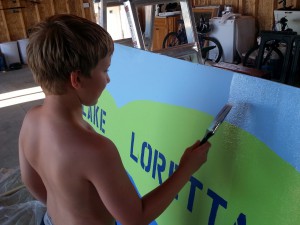
To their credit, both Moira and Maclane had decided months ago what they wanted to do for their fair entries: Moira would refinish a dresser once owned by the late Joe Brown, and Maclane would create a new sign for the late Bruce Bielenberg’s Lake Loretta.

There’d been talk of photography exhibits, baking, gardening, maybe even a little knitting, but when 4H crunch time hit, they both chose to focus on one large project. Again, I have to give them props because they certainly didn’t gain this less-is-more mentality from their mother. I’m notorious for taking on more than I can handle . . . must be those sensible Murrell genes.

For this, I am grateful, because shouldering just the one project held within it many more meltdowns within the two-week 4H crunch time than I ever could have imagined. Literally spitting mad, Moira would burst through the backdoor, gagging and yelling. “Sanding is terrible! It keeps getting in my mouth!” (Maybe next year we’ll remember to dig out the dust masks?)

2014-07-09 09.19.32Then there was Maclane’s behemoth eight-foot-by-four-foot sign that required the same design be painted on both sides. He struggled with the design process and accepting that the little, happy trees in his mind are not easily translated onto canvas, er, plywood.

And just managing the size of the project, sent him spinning. More than once hot tears sprang loose when a strong wind would come up and blow the sign over. Admittedly, there were moments when I wanted to get in there and help him, but Marty and I agreed, they must do their own work.

In spite of the heavy angst each project caused the kids, they hung tough. Neither were easy, nor impossible . . . it’s weird how they each chose the perfect project for themselves.

That’s what is so impressive about the county Fair and touring the auditorium where each club displays the efforts of its members. The creativity, ingenuity and unique designs are inspiring! Every year, without fail, I end up strolling around with the same giant, weirdo smile on my face—we grow great kids here in Clinton County!

And though Moira and Maclane didn’t execute their projects for the accolades, it’s what they received! Each were practically floating on Monday when, during the judging process, they both learned their entries were considerations for the state fair.

I really hate to admit this, but selfishly I’d hoped they’d remain considerations. How could we possibly fit a visit to the state fair into an August schedule that’s already laden with a week-long vacation and the annual insanity that is our early school start?

And then there’s the potential heartbreak and havoc of having one child’s project make it to the state fair and the other not. Sure, we’d navigate those waters just as we’ve done every other crisis, but . . . fortunately for 2014, we don’t have to.

As luck would have it, we don’t have to find out: BOTH ARE GOING!

This is truly a fresh experience as neither Marty nor I had any project at the state fair. Though my nephew, Jacob Reemstma has shown livestock, this is virgin territory for our gang!

So I guess we squeeze a second trip into our tight August schedule. I think it’ll be worth it. While the state fair is a big deal, I believe the best part of this year’s 4H projects happened the day before our local Charlotte club show on July 11.

Moira walked up to Marty and asked, “So what furniture can I do for next year?” Do I dare hope she start that project sooner?


Originally published 19 July 2014 in The Observer.

Grateful to put county, state fairs behind us


What was the best thing about the 2014 Iowa State Fair? Leaving.

I’M SORRY!!! Between the crowds, the sun and the motorized scooters, I just couldn’t take it! I keep thinking if I’d had an umbrella with me, to provide perpetual shade, then maybe I could’ve sucked it up. But the little I saw showed me little has changed since I last visited the fair in 1995.

Dad Olson poked fun, “You mean to tell me, you run all these races, out in the heat, and you couldn’t take the fair?!” Yes.

In my defense, my miles and racing drop significantly in the summer. And when I do run, I’m mentally prepared for the gross dirtiness (and it’s usually at some ungodly pre-dawn hour).

mo 4h dresser ribbon winnerThe weather, as many of you know, has been quite mild, but bright, blinding sun does a number on me. No, I’m not some delicate flower. I think I’m more vampire.

Even so, I just couldn’t get excited for the state fair. This lack of interest wasn’t helped when the night before, my father-in-law, who’d just come from the fair and seen Moira’s blue-ribbon Joe Brown dresser and Maclane’s red-ribbon Lake Loretta sign, told Maclane he thought his sign would’ve earned a blue ribbon if his project book had made it to the fair.

WHAT?!!! The next 18 hours was a mix of high-pitched emotions ranging from my husband emailing ISU Extension and ringing up different county fair board members to my son crying himself to sleep.

Marty, I and the kids all agree it was a painful lesson in not leaping to conclusions. Just because someone says it’s so, if we’d waited and seen for ourselves, Marty’s lunch would’ve had fewer feathers and Maclane’s pillow, less sodden.

WP_20140709_003Turns out, after making our way from the north entrance of the fairgrounds all the way to the southern edge and the Poultry building where the 4H exhibits were displayed, it was written right on Maclane’s tag that his project book was, in fact, there. There was no way of attaching the book to his project, so his along with other books detailing other projects, was kept in a separate area of the building where visitors could ask to see it.

I was simultaneously relieved and livid. Maclane and Marty had been put through hours of wasted emotion, yet it was wonderful watching Maclane’s attitude transform. From slow-footed and frowny to skipping and gleeful, proud of his red ribbon, the boy was back to his wise-cracking, comic self.

After snapping pictures of Moira with her gorgeous dresser and Maclane with his colorful sign, we headed to the cattle barn to meet up with my sister’s family, the Reemtsmas. While Moira and Marty were excited to see more sights, Maclane and I, along with nephew Nicolas were ready to leave.

The grit behind the livestock fanfare

Walking through the cattle barn was probably my favorite part of the whole fair. I’d much rather walk up and down the rows of cattle pens vs. stand in line to see the Butter Cow. To see how different families camped out, with food spreads, lawn chairs and hammocks was fascinating, likely because I grew up on what I used to call a “nice” farm i.e. just crops, no manure.

As a kid, I loved not living with the aroma of hogs and cattle, but as an adult? There’s a certain ‘grit’ one develops when working with livestock. Watching Phil and Jacob fluff up the steer’s coat, Phil working a brush on the legs while Jacob wielded a blower, I couldn’t understand how the beast was so still, how Phil wasn’t getting kicked in the head.

I may have thought such detail work was reserved for a couple weeks during fair season, I was quickly informed this is the daily grind for many “real” farm kids. The feeding, the cleaning, the walking, the brushing, the washing—all in a day’s work. I can’t help, but giggle thinking this is my sister’s brood.

In June, having stopped by Angie’s place for a visit, a nearby oinking alerted us to a hog on the lam. Looking north into their pasture, we saw cows curiously walking along the fence-line, following the jaybird-hog.

With the Reemtsma men away, we took it upon ourselves to right the situation. Despite her best efforts to scold the pig into submission, clearly Angie (and I) were ill-equipped to deal with loose livestock.

While it’s one thing for a mother to threaten and coerce her daughters into modeling their sewing projects, clearly it was Angie’s lost battle trying to reason with a pig.

Had we been real farm girls, maybe we would’ve know that a boot to the side would’ve nudged the pig along. That a rightly swung shovel provided more motivation than a stern look and a hand on the hip as Angie yelled, “Bad pig! Go to your pen!”

Such is life on a real farm.

In spite of my lack of enthusiasm, I think our area kids, not to mention my family, did pretty dang awesome in the world of fairs this year.

And though Maclane and Nic were happiest while swimming at the hotel, and Angie and I, resting pool-side, Marty and Moira “fair’ed” their hearts out, returning to the hotel that evening, bellies full of cotton candy and funnel cake.

I can’t be the only one who’s glad it’s over, can I?


Originally published 16 August 2014 in The Observer.

Triathlon: From sprint to 70.3 in 12 months


At this time one year ago I was in the final days of training for my first triathlon, DeWitt’s own Crossroads. Last weekend I completed my first Ironman 70.3 in Racine, Wisconsin.

I’m sharing this not to brag or boast, but to encourage any of you who ever had a whisper of a thought like, “Could I?” to prove to you, “Yes, you can!”

When I completed last year’s Crossroads, my goals were pretty simple: don’t drown, don’t crash, don’t crawl. Time? Reaching that finish line was Numero Uno.

After I finished, I was quite certain I’d do more triathlons and within just a couple of months, with one sprint tri under my belt, I registered for a half Ironman. A couple of my training buddies found it humorous that I’d take such a leap, but given my propensity for action before thought, it made perfect sense to me.

Racine 70.3I am lucky to have a host of local friends who regularly do this type of sport. They are completely to blame, not only for infecting my goals, but also in seeing I achieve them. While some people may have the moxy to train and prepare without the support of others, I am not that island.

So how does a half Ironman compare to a sprint tri? At the Crossroads, the swim is 500 yards in Lake Kildeer compared to Racine’s IM being 1.2 miles in Lake Michigan. The bike is 15 miles of rolling hills as opposed to 56 miles of mostly flat, though bumpy roads with the run being a single 3.1-mile out-and-back route compared with a 2-loop, moderately flat course totaling 13.1 miles.

Because I’d already done plenty of running this year, I cut back my normal running schedule and focused more on swimming and biking. Factor in that I’m an old RAGBRAI’er at heart, even the biking wasn’t too strenuous as muscle memory, even from years ago, allowed me to ramp up my mileage fairly quickly. That, and finally, after enjoying my road bike since 2000, having a “fitting” done.

With several people referring me to Dan Adams at Healthy Habits in Bettendorf, he put my bike on a trainer, watched me ride and then began tinkering. He replaced my stem, handle bars and bike seat, added aero bars and with mere millimeters of adjustment, had me feeling so fabulous I’d swear it was a different bike!

The only thing left was to address my swimming. Throughout the winter, my friend and trainer Ray Porter had dissected and rebuilt my crawl stroke to improve efficiency and power. That’s well and good, but last month’s QC Sprint Tri proved the second I hit open water, anxiety completely renders me incapable of anything other than laying on my back and kicking my feet.

I’m not afraid of the unknown beneath me and while I initially thought it had to do with the feeling of my wetsuit around my neck, is something weirdly mental that seems to only happen in open water. Does it go back to my days as a lifeguard at Wacky Waters when we’d do early-morning lake searches for possible drowning victims? Who knows, but it certainly could.

Fortunately my open water freak outs began decreasing thanks to specific breathing exercises that address the limbic system in my brain where my emotions are controlled. (Like I said, WEIRD.) These, coupled with doing more open water swims at Scott County’s Lost Grove Lake and Lake G, helped get me comfortable in my wetsuit.

But no matter what kind of preparation a person does, once you stand on the shores of Racine’s North Beach and stare at that massive body of water that you’re required to swim in? The prayers come quick and fast.

Fortunately I was not alone in this endeavor as DeWitt resident and local trainer Matt Dingbam of No Limit Fitness and his student (my cousin-in-law) John Melvin, also of DeWitt, committed to the Racine IM, too!

Each of us had our own reasons for doing so and our own goals to reach. And reach them we did! For now, however, I’m saving the experience for next week to encourage you to participate in next week’s Crossroads Triathlon, Saturday Aug. 2!

Whether as a member of a 3-person team or solo, it’s a wonderful event for a first-time tri. It’s not too late to get in on the fun so visit www.crossroadstriathlon.com for event information and registration.

You never know what you can do if you don’t try, or what dreams and goals a tri can unleash!


Originally published 26 July 2014 in The Observer.

Traithlon: Three athletes—one goal—all Ironmen


I’ve seldom met a hair-brained idea I didn’t like, and apparently I’m not alone! Enter No Limit Fitness owner Matt Dingbam and his client-friend (and my cousin-in-law), John Melvin.

Both DeWitt residents and I were among the 2,606 athletes who competed in last month’s July 20th half Ironman in Racine, Wisconsin.

I remember speaking briefly with Matt at last year’s Paul Skeffington Memorial Race during which we both mentioned the I-word. Forget the fact neither of us had an ounce of experience with triathlon, the idea of taking on an Ironman was brewing in each of us.

flat jenny Racine 70.3 2014While I’d run countless races including several marathons, that Skeff Race was quite special for Matt and John. It was their first. EVER.

Their experience in DeWitt, from the cheering crowds to seeing family members on the course, prompted the two of them to sign up for more races throughout 2013, culminating with the IMT Des Moines Marathon in October. From 5 miles to 26.2 miles in four months! Even I’d call that cray-cray!

This seemingly over-zealous approach to running offers us a peak into the psyches of Matt and John. Meeting each obstacle with fortitude, each goal with tenacity, it’s no surprise neither man shied away from the challenge of the 70.3, which represents the cumulative mileage of a half Ironman—1.2 mile swim, 56 mile bike, 13.1 mile run.

While I’ve logged thousands of miles on foot and bike, and probably as many laps as far back as college, I had a smidgeon of what would be required of me. Matt and John? Gut instinct, alone.

“I had always thought about triathlons,” Matt told me, “but I had never even road biked or really swam for distance. I decided to ‘Go Big or Go Home’ and signed up for Ironman Racine, knowing I would figure it out along the way.

“Of course, John Melvin followed my lead as he did not want me to do this alone!”

John and Matt knew each other, but it wasn’t until John began attending boot camp at No Limit Fitness when Matt unlocked John’s potential and the two developed a friendship that would transform their goals into a partnership.

Matt came at the 70.3 with calculated training and focus while John brought the grit, fine-tuned by his years in the military.

“I’ve always reminded myself to ‘Embrace the Suck,’” noted John, using a mantra made common by Iraq war veteran and writer Col. Austin Bay.

“The truth is that my preparation plan was changed constantly due to weather, work, family, money and any other reason.”

In fact, John’s work took him out of country to India for three weeks during the final month before Racine. As if the surroundings weren’t taxing enough, the 16+ hour work days prevented any training and it was then that John decided the Ironman was lost.

Perfectly understandable, life getting in the way and all, skipping the Ironman gnawed at John. Yes, the training wasn’t there, “but why not try?” he wondered.

At the last minute, John opted to ‘Embrace the Suck’ at a level few of us will experience. “Using this logic,” he explained. “I’ve been able to adapt to obstacles on and off the course that are always working to keep you down.”

He, Matt and I met up at the Ironman Expo the day before the race and then John and I drove the bike course.

It was during that drive when he verbalized the essence of strength: facing the fear regardless of outcome. Fear of the unknown robs so many from achieving greater heights. Sure John wanted to finish, but it was facing the possibility of trying and not finishing that was his foe.

But is it such a novel foe? Matt, John and I all brought our own fears to the 70.3 table. Turns out all three of us were less than enthused about the swim in Lake Michigan.

“When I arrived at Lake Michigan I got a sick feeling,” Matt admitted. “I could not quit looking at the lake and wondering how in the world I was going to be able to swim 1.2 miles in this huge body of water.”

Though water temperature was a chilly 61 degrees that Sunday morning, we were lucky to have calm conditions and a glass-like lake. Starting in waves divided by gender and age, we each navigated the breath-stealing cold and fell into steady swims that, once finished, buoyed our spirits for the remaining bike and run.

While Matt and I were confident of our abilities on the bike, John faced the real “meat” of this challenge during the ride. Prior to the Ironman, the longest John had ridden was 25 miles. Aside from the common aches and pains every cyclists copes with, John rode a borrowed bike in which the seat sloped downward. This would be his proverbial shining hour, shining four hours, to be exact.

He knew he could probably reach the 30-mile point, and the 13.1-mile run? If all else failed, he could walk it, but those final 26 miles on the bike? It was a giant, looming cloud of wonder that he answered with a ROAR by cruising through those 26 miles and on through the run.

All three of us reached our goals.

For Matt, this was his first triathlon and he finished in 6 hours and 28 minutes. “The sense of accomplishment and ‘runner’s high’ lasted for two days straight!” In the Finisher’s Tent, Matt met Lionel Sander, the overall winner who snagged victory with a time of 3:45.

“Even though I was totally satisfied,” Matt said, “I knew I would need to do a full IM (Ironman) to reach my full goal! At the same time I was thinking this, I got a text from John that said the exact same thing!”

For John, this was his second triathlon and despite the training woes and borrowed bike, he conquered the fear and crossed the finish line at 8:04!

“There was a time when the Crossroads (Triathlon) was the most difficult obstacle in front of me, then a marathon, then a 70.3,” John said. “My point to anyone thinking about doing something outside the box is this: keep moving forward and focusing on your goals. Everything else always seems to fall into place.”

Myself? I came in at 7:03, 27 minutes ahead of my goal! And yes, as with Matt and John, I too have set my sights on the bigger, badder full Ironman: 2.4 mile swim, 112 mile bike, 26.2 mile run.

Matt put it best, “To be continued . . . when (we) sign up for the 140.6.”


Originally published 2 August 2014 in The Observer.