Like a cruel ding-dong ditch ‘em, ‘Menopause’ comes a’knockin’


Last Sunday, I sat in the fourth row at the Adler, listening to a quartet of women sing about my life. Honestly, I’d hoped the topic would sail over my head, that the theme would be some unfamiliar nether issue waiting for me many years off in the future. Sadly, “Menopause the Musical” hit every stinking note with surprising precision.

Is that “TMI” (too much information), that I’m sitting squarely in the midst of “the Change?” Tough. It has/is/will effect half the people on this planet so why shouldn’t we talk about it? And yet our culture, for as progressive as we may think ourselves (well, maybe not so much after last Tuesday) we continue to dance around the issue.

At least the musical gave good beats with which to do that dancing.

I knew I had a few telltale symptoms, but as each scene passed and the songs built one on top of the other, I was aghast at how strongly I could relate to the four women on stage. No offense, but those four women looked much older than me!

Not that they weren’t attractive, mind you, but they certainly weren’t 35. And neither am I, even though my mind would have me believe I’m still in my early 20s. Where did the last two decades go?!

I guess I can thank the women of the Baby Boomer generation for not going quietly into that dark “Change,” but I don’t know how ready I am to join you.

Once the 1980s gave way to the ‘90s and I no longer required cans of Aqua Net to set my hair skyward, increasing my height a solid 6 inches, I slowly drifted away from worrying about my looks.

Maybe it was the “freshman 15” in college or maybe it was just the style of the times: large, flannel shirts and grunge music, but somewhere along the way I lost the ability to be “girlie.”

Sure I might wear a bit of makeup, but any concept of how to accessorize scarves and beads and earrings and bangles was snuffed out by my penchant for plaid button-downs and KSwiss sneakers.

And my fashion sense hasn’t improved much. Instead of the oxford shirts, it’s race t’s. The KSwiss tennies have been replaced by whichever running shoe currently holds my orthotic inserts.

So what does this have to do with menopause? In spite of my best efforts to shun my gender, I am indeed a woman . . . and boy do my hormones ROAR!

Take the night sweats . . . the heat I emit is similar to that of a self-cleaning oven, as if I might set the bed on fire. I was running with a girlfriend earlier this week who told me that when she suffers night sweats her husband asks if she’s sick, “Do you have a fever?”

There are times I’ll wake up FREEZING and drenched, leggings, long-sleeved t-shirt and my entire side of the bed, soaking wet. Gross? Well, apparently that’s just run-of-the-mill menopause.

During Sunday’s performance, one of the characters made mention of waking up in a puddle and not knowing whether to change the sheets in the middle of the night or simply lay down a towel and go back to sleep.

Are there hidden cameras in my bedroom?! There’s only one way writer Jeanie Linders could’ve known that about me and that’s if it happened to her and a host of other women. And yes, my running buddy admitted it happens to her, as well.

And speaking of sleep, I never realized my lack of continuous shut eye was menopause related, but when the musical hit that note, I was reminded how over the last couple of years, I’m waking more and more often for no reason and struggling to fall back to sleep.

My doctor recommends I take Black Cohosh, morning and night, but I haven’t noticed much of a difference.

The differences I AM noticing are those marching across my body, starting with my face. I remember my skin being younger-looking, more like Play Doh, smooth and healthy. But now? For the first time I’m noticing wrinkles in new places. My forehead is creased with many and varied lines and my dimples no longer seem youthful, but rather sad and weathered.

And that area between my neck and chest, the décolletage? Let’s just say that if it wasn’t for the dang hot flashes, I’d wear turtle necks year round! Where did all those freckles and furrows come from?!

Maybe this is why I abandoned my “girlie” side years ago, maybe I secretly hoped that if I ignored the “girlie” part of me and focused on the “biking, running, sporty-Grrrr” part of me, I wouldn’t be bothered when age came a’knocking.

But guess what, I’m bothered.

While I’m not ready to delve into wrinkle creams, age-fighting serums, Botox and all the other “solutions” the beauty industry is hocking, I am beginning to understand on a very personal level why women pine for such treatments.

This aging business is quite disturbing. For someone like me, who really didn’t care about all that, to suddenly care about all that?! It’s weird.

I can only imagine how freaked out normal women must be, women who actually put an effort into coordinating an outfit and putting on make-up. In my effort to set myself apart from all of you, I find that I’ve been right beside you all along.

Hopefully next time you see me and I’m lathered like a horse, you’ll know I’m just struggling through a hot flash. Misery loves company, so please don’t let me suffer alone, remind me you know how it feels. I like empathy.

Girlfriends, let’s help each other through this! No matter how different we each choose to cope, let’s have each other’s backs on this and just do whatever we must. Me? I think I’ll sign up for another race . . . and slather on extra sunscreen.


Originally published 8/15 November 2014 in The Observer.

Film, music & make-up: a great week of area entertainment


Movies and mayhem, both musical and otherwise. What a week it’s been!

Without a doubt, Monday’s premiere of the documentary “West By Orphan Train” at DeWitt’s Operahouse Theatre crushed anyone’s expectations.

Hosting the event was the Friends group from the Frances Banta Waggoner Community Library and we offered a secret preview that afternoon to residents of local assisted living facilities. With 10 people attending from Maggie’s House in DeWitt and another 20 traveling from Grand Haven in Eldridge, we had a solid start to the day’s event.

orphan train mo & mac behind depotSpending the remainder of the afternoon with film director Colleen Bradford Krantz and Clark Kidder, author of “Emily’s Story,” I took them to Ann Soenksen’s to show Kidder where his grandmother’s school would have stood while also allowing him to visualize the general area of the Pelham Farm where his grandmother lived for several months. Eventually we stood at the Malone train crossing, where Emily arrived in Clinton County via orphan train from New York.

When we returned to DeWitt and walked toward the Operahouse at 5:30 Monday night, people were already trickling into the lobby. By 6:10 p.m., as Kidder’s book supply started running low and the crowd swelled, all of us began to fret over the theater’s capacity of 236.

Within 20 minutes, the house was full!

Opting to offer a second showing, we rolled the 60-minute film early and had another 150 people return at 8 p.m. for that screening!

While hindsight remains 20/20 and both Krantz and Kidder agreed the afternoon preview would have been a great option for others, no one could have prepared us for the wonderful interest in this project.

Admittedly, we live in a pretty cool area. Not only do we support the arts, but we have a solid interest in the orphan train story due, in part, to the Delmar Depot.

Many people connected with Krantz and Kidder, sharing stories of family members who came to the Midwest on an orphan train. One of the more exciting meetings was with a Muscatine woman whose mother was an orphan train rider and is still alive!

Iowa Public Television will be partnering with Krantz and Kidder for another local showing at Davenport’s Figge Art Museum, Sunday Nov. 16 at 2 p.m. A tentative IPTV airing is set for Monday, Dec. 1 at 7 p.m.

As if I didn’t get my art “fix” Monday, Tuesday was the Northeast Marching Band Extravaganza in which both the middle and high school marching bands performed in the gymnasium.

When we moved our family into the Northeast School District nearly a decade ago, we attended a football game and watched a small, rather rag-tag marching band take the field. Both Marty and I came from strong high school music programs and we were adamant that both our children participate.

In the few years since our first experience watching the Northeast Marching Band, the program has burgeoned under the tutelage of Gerald Creger, Matthew Bolahan and Laura Horst, making Marty and I (selfishly) very excited for the coming years!

During Tuesday night’s concert, the middle school band began their set with Deep Purple’s “Smoke on the Water.” I barely stifled a giggle as Creger prefaced the song by claiming it’s a mainstay for anyone with a guitar, electric or air. Myself? I remember killing it on the keyboard. Seriously, few are the chords less familiar!

After a smokin’ hot rendering of that classic, the band proceeded with the theme from “The Pirates of the Carribean” before closing with an impressive parade number.

Prior to the high schoolers taking the floor, Creger noted the band participated in the Musky Marching Invitational in Muscatine where they won the third place trophy. They also took part in the Iowa High School State Marching Band Festival at the newly renovated Brad Street Stadium in Davenport where they achieved an ‘Excellent’ rating.

The gym then filled with the music of Billy Joel, a multi-piece homage titled “Piano Man-the music of Billy Joel.” From “Only the Good Die Young” to “Air” (Dublinesque) it was both exciting and gorgeous to witness.

Hats off to the seniors and we excitedly wait the 2015 season to hear how the younger performers try to fill your shoes. Great work and many thanks for all your hard work!!!!

And finally, what Halloween is complete without ghouls, especially in Charlotte? Yep, the local haunted house is baaaack!

After 2012’s sudden and soul-crushing closing of the Charlotte Haunted House, Mike Jensen and the rest of the Citizens For Charlotte crew resurrected this community tradition inside the walls of the old stone Charlotte school.

With last weekend’s opener attracting nearly 1,000 people (official headcount was 989), it’s clear this town gives a great scare. Consider joining us tonight for the final screams of the 2014 season!


Originally published 1 November 2014 in The Observer.

Movie sheds light on orphan train history


It was 2000 when I first heard about the orphan trains. I was working as a stringer for The Quad City Times and was assigned a piece on the Delmar Depot and a Maquoketa man who landed in the area after riding an orphan train from the east.

He was quiet and kind, showing great patience with my nervous, cub reporter-self. Inviting me into his home, I sat with him and his adult daughter while he shared his experience.

wilton orphan depotIt wasn’t a happy one. I remember he swallowed back tears telling me of the pain he felt being given away. He talked of being taken in, not as a son, but as a farm hand, and how the other kids at the farm would make fun of his eastern accent, specifically for how he said the word “horse” as “haws.” He said it was hard coming on an orphan train because, as he put it, he wasn’t wanted.

Not to wax saccharine, but in spite of this man’s sad start in life, I remember looking at his daughter and thinking of the love he eventually found in marriage and creating his own family. Surely it doesn’t replace the early love lost, but it must’ve filled at least a little of the empty space. My inexperience cost me. I didn’t ask the question, and he’s since died, taking his story with him.

Oddly enough, what Wisconsin author Clark Kidder wrote in “Emily’s Story” about his own grandmother’s coming from New York to Iowa on an orphan train echoed a similar experience.

First being taken in by the Pelham family of rural DeWitt, Clark noted it wasn’t a good environment for Emily. She was then taken in by a LeClaire family. Again, more pain awaited her. In fact Emily was never formally adopted, rather she grew up in Wisconsin, staying with families that gave her shelter in exchange for housework and childcare.

As with the Maquoketa gentleman, Emily’s joy did not take flight, it seemed, until a friendship with Earl Kidder sparked into romance and a family of her own grew up around her.

Since that mid-90s newspaper assignment the story of the orphan trains remained a part of me. Maybe it’s the regular drives through Delmar and past Maria Casad’s shadowy mural of train passengers, or maybe it’s the unsettling disbelief that such things took place for 50+ years from 1854 to 1930.

Given today’s standards for adoption, it’s surreal to imagine loading trains with orphans and indigent children, and sending them blindly into an unknown. Obviously organizers hoped they would find new, loving families, but there were no guarantees.

As the children were paraded across stages like that of DeWitt’s Operahouse Theatre, reciting a poem or a psalm, they could be taken into the home of a predator just as easily as that of a caring family, eager to give shelter and love.

I still question why I never learned about it in school, as if it was some ugly mark kept hidden, forgotten in a corner of our history. I marvel at how few people are aware of this period. While the movement was sparked out of concern and love for those children, as with so many altruistic efforts, pure intentions are easily sullied by the harmful actions of a few.

Monday the history of this orphan train experiment will come to the big screen in DeWitt with the premiere of the film “West By Orphan Train.”

Through an odd twist of events, Clark reached out to one of my dearest college friends, Colleen Bradford Krantz whose 2010 documentary “Train to Nowhere” on illegal immigration, sparked her book of the same name.

Clark pitched the idea of doing a documentary on the orphan trains, using his grandmother’s story as the framework. Colleen agreed and pulled in Iowa Public Television to partner on the project.

In planning the film schedule, Colleen realized how close my daughter, Moira, was in age to Emily when she rode an orphan train to Malone Station east of DeWitt. With Moira portraying Clark’s grandmother, additional children were needed to portray other orphans and Maclane happened to fit one of the costumes, serving as an extra for filming at the depots in West Liberty and Wilton.

Even though witnessing movie magic was an enjoyable experience, it remained a sad look at our nation’s past. Watching Moira wander, alone, along Anne Soenksen’s property near the original Malone Station; seeing Maclane sit on a suitcase and stare across the West Liberty railroad tracks . . . my mind continued to turn over the sadness experienced by so many young ones.

Reading “Emily’s Story,” I gaped at the strength necessary to withstand rejection at such a fundamental level, in many cases by your own family and then by adoptive families taking you in solely for your ability to work.

Seeing mine and the other children in period dress left me emotional. Their little bodies. Their long, sad faces. It was hard NOT to imagine the fear Emily and thousands of others must’ve felt as their trains chugged toward the next stop . . . being marched across a stage, holding their backs straight, chins up, hoping to be chosen by a nice family.

I know not every story was one of sadness. In spite of her tough start, “Emily’s Story” is a beautiful telling of one girl’s willingness to persevere. In fact, after my book club read it, a single word, “spitfire” continually sprang to mind whenever I thought of Emily. She simply never gave up. And thanks to her grandson’s book and Colleen’s film, her story and that of other orphan train riders are preserved for the ages.

Monday, consider joining Clark, Colleen and the Friends of Frances as we host the premiere of “West By Orphan Train” at The Operahouse Theatre. This free event begins at 6 p.m. with Clark signing copies of “Emily’s Story.” The movie will show at 7 p.m. and a question-and-answer period with Colleen and Clark will conclude the event.

*Unfortunately I was unable to locate a copy of my orphan train piece in the early 2000s and did not want to risk misidentifying the name of the Maquoketa gentleman I interviewed. My deepest apologies for the omission.


Originally published 25 October 2014 in The Observer.

Old Farmer’s Almanac 2015 forecast


The opening verse of the song “Like the Weather” by 10,000 Maniacs pops to mind during cold, rainy periods such as the recent soaking we suffered earlier this week. . .

              “Color of the sky as far as I can see is coal grey.

              “Lift my head from the pillow and then fall again.

              “Shiver in my bones, just thinking about the weather.

              “Quiver in my lip as if I might cry.”

Those dreary days can be easily forgotten as Wednesday gave way to gentle fall conditions. Is anyone with me in noticing the tree color? Could I be hallucinating or do the reds seem incredible this year? Even the sumac, usually a gorgeous deep burgundy is a flaming candy-apple red in many places!

I suffer such a love/hate reaction to this time of year. One the hand, the temperatures are falling and the changing leaves are lovely. But on the other hand, days are shortening . . . and I need my Vitamin D!

Admittedly, my schizophrenic-like attitude toward the weather is one in which I’m seldom content. Heat is my constant foe, and humidity? Forget it! I will never complain about the cold because you can always put on more layers (though my sisters would argue otherwise). But during those thick, steamy days of summer? You can only get so naked before you’re arrested, and then you’re still gross and sweaty!

In spite of my aversion to warmer climes, I must admit my recent sadness. All the glorious leaf colors and cooler temps serve as sentinels to my seasonal depression, heralding shorter days, cabin fever and miles waiting to be slogged on the treadmill.

While I truly appreciate temps in the teens, the limitations winter places on our lives is a total bummer. Thanks to wool socks and all sorts of layers, at least the cold and wind do not imprison me. But snow and ice? Yeah, I’m out . . . or rather, in.

When I asked my 11-year-old son his thoughts on the coming winter, he shared his excitement, claiming “there’s more to do outside during the winter.” Maclane noted sledding, snowboarding, snowball fighting. (I’ll remember this when he wants to be a toad, sit on the couch and play Minecraft all day.)

It was about six weeks ago, listening to Iowa Public Radio’s “Talk of Iowa” with Charity Nebbe, that I caught her interview with an editor of The Old Farmer’s Almanac.

The winter forecast? Cold and blustery.

Seriously? After last winter?! Honestly, I hate to complain about last winter, but even I found it a little . . . long.

And now it would truly seem that our last hot days are behind us. Hurray! But does that mean I’m ready for cold and blustery? Nope, which is why I opted to snag a copy of the 2015 edition of The Old Farmer’s Almanac to find out for myself all that next year has in store for us.

Scanning the table of contents, there’s an actual guide to using The Old Farmer’s Almanac, a good thing considering there are parts which read like Galileo’s notebook. The calendar pages are the meat of the almanac, “these pages are unchanged since 1792, when Robert B. Thomas published his first edition. The long columns of numbers and symbols reveal all of nature’s precision, rhythm and glory, providing an astronomical look at the year 2015.”

One thing I remember from the public radio program was that the Almanac claims to have an 80 percent accuracy rate. Googling the question, “How accurate is The Old Farmer’s Almanac” I found many sites itching to complain about such a boastful claim.

A meteorologist writing for Slate, an online magazine, reported “Independent verifications of its forecasts by actual meteorologists over the years showed skill that was ‘laughable at best and abysmal at worst’ with accuracy about as good as a coin toss.”

But doesn’t longevity give its predictions a little cred? The Old Farmer’s Almanac has been released continually on an annual basis since first published 1792. And come on, am I alone in believing the science of meteorology can be a tad “iffy” at times?

While science is reporting a “warmish” winter, The Old Farmer’s Almanac is predicting temperatures, precipitation and snowfall “below normal.” Could this be an indication of less ice i.e. fewer miles on the treadmill? Time will tell.

But as I read further, it was next summer’s prediction that had me groaning: “hotter and slightly drier than normal.” Though that could indicate a possibly less humid summer, it sounds like a scorcher could be in store.

In the meantime, I guess I’ll just enjoy fall while we have it: the beautiful colors, the milder temps, and the last few passes with the lawnmower before winter arrives and I batten down the hatches.


Originally published 18 October 2014 in The Observer.

Marathon joy found in miles of smiles


Last weekend saw the 17th running of the Quad Cities Marathon. I wasn’t looking forward to it.

Since July’s Ironman 70.3 I haven’t been doing much training. Sure I had a few events since then: Bix, Ragnar Great River, Glow Run 5k, Clinton Half Marathon 10k and Iowa’s Best Dam Tri (sprint). But I wasn’t fired up about a single one of them. I was tired.

So why didn’t I take some time off? Fear. Irrational fear, at that. Despite knowing I have a fabulous group of training buddies, when I get scared, I forget that everything is ok and will be ok. I forget that taking a break will not send me back to the nether regions of life before I started running. I forget that breaks are actually good for the body. Hindsight remains 20/20.

By mid September, however, I was beginning to feel the old mojo return. Fresh off witnessing training buddy and friend Laura Snook from LeClaire complete Ironman Wisconsin (2.4 mile swim, 112 mile bike, 26.2 mile run), I waffled on whether to change my QC Marathon registration from the full to the half.

When Laura reminded me the marathon would be buddy Marilynn Bartels’ first marathon, we opted to stay at the full distance and see Marilynn through to the end.

I remained leery because I hadn’t run long since June, but by the time I arrived in Moline on race morning, I was excited to be doing it with so many friends.

Sunday was my 11th marathon and I can truly say I’ve gained more than just a medal from each one. But the most important thing I’ve gained is friends. While it may sound a little pithy, it’s true!

My first marathon was Chicago 2010. I didn’t know anyone and because much of my training was done solo, I thought marathoning was a solitary endeavor.

The following spring I ran the Illinois Marathon for my second and wrote the following Facebook note to my family:

In the summer of 1994 when I interned at The Observer, I took up running—laps and laps around that wee lil’ track in the Hart Center (DeWitt Fitness Center).

When I wasn’t doing that, I’d be bugging Gramma Kroymann at J & K Kids (now home to Family Tree consignment shop). One time when I’d come in from a run, she told me I was nuts and that I should put on some makeup.

Fast forward to April and the Illinois Marathon, somewhere in the final mile. I was fading and just trying to make it to the finish. I started thinking about prayer and how it didn’t feel right to ask for God’s help since I wasn’t running for a charity and I’d voluntarily put myself there.

Then I thought about Grampa Kroymann and then Gramma and instantly heard in my head, “You IDIOT! What are you doing?!” with the image of Gramma standing by her microwave doing a fake little faint and slapping the counter with an exasperated sigh. I smiled a little and then went back to focusing on the misery of this last mile.

The route went under a train bridge and just as I was coming out from under it, I started to walk. That’s when some guy in an orange shirt came up from behind me and said, “Come on Baby Cakes! We’re gonna do this thing together! I’ll run with you!”

So I ran with him a few strides and then told him I had to stop. That’s when he grabbed my right hand and started pulling me along. “Come on! You can do this! We’re going to finish this with a 4 in front!” (Meaning in under 5 hours.)

He pulled me along for about a half mile. At one point, I said to him “You’re so kind.” He replied, “Hey, we’re all family out here! marathon cupcakesWe help each other out!” I have to admit that A) it was a little weird holding hands with this guy, but whatev; and 2) what was Marty going to think when he saw me run into the stadium all cozy with this guy?!

I finally had to tell him, “I gotta let go.” And then he released my hand. I don’t remember if we said anything more to each other, I only remember his orange shirt. With only a quarter mile left, I figured I’d find him afterwards and thank him. But I couldn’t find him! ANYWHERE!

A few days later, after I’d been telling everyone about my ‘Angel in Orange’ it dawned on me that mere moments before he came up on me, I’d been thinking about Gramma, secretly asking for some help….

Even in my idiocy, Gramma continues to watch over me, offering little nuggets of aid in the strangest of places and ways.

~Now it’s three and a half years later and I get it! I “get” why my ‘Angel in Orange’ did that for me! It’s not about the time clock, it’s about the time: not in minutes and seconds, but in people and smiles!

We thanked the volunteers and Hi-5’ed the kids! We shouted encouragement to our fellow runners and mugged for photographers! We even sang, “Everything is AWESOME!” from the Lego movie!

~Sure we suffered—it was hot and the last 6 miles are a soulless lesson in punishment. In spite of the many impressive PRs logged that day, Laura summed it up best when she said, “This is a PW, personal worst.”

But we knew when we laced up that morning, it wasn’t about us, it was about Marilynn . . . and that little minx did wonderfully! Just after Mile 19 as we approached the final bridge off Arsenal Island, Marilynn started bee-bopping off ahead of us, smiling and chit-chatting with a runner who joined us a few miles earlier.

About a mile ahead of us, we saw her again after she passed under the inflatable Wall, smiling and waving at us heading into the 23rd mile.

When Laura and I eventually crossed the finish line, we’d logged one of our slower marathons, but for me, it was one of my most enjoyable. Having been so wrapped up in dread beforehand, I’d forgotten how fun running for the heck of it could be.

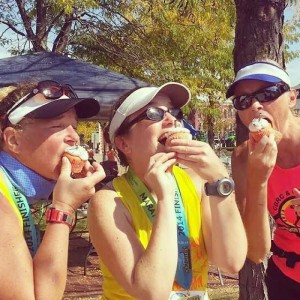
We accomplished our goal, seeing Marilynn through her first marathon, the rest was icing on the cupcake!


Originally published 4 Oct 2014 in The Observer.

Luck be not the lady for me


I tend not to pay attention to luck as I’ve resigned myself to having very little of it. That’s not to say I’m a pessimist, I’m just not the one to win playing scratch tickets and my number is rarely drawn for a prize.

However, I’ve got a pretty great life, but luck has very little to do with it. For me, I think it’s more about simply doing the best I can and trusting that things will work out. And they always do . . . just usually not according to my plan or timeline.

Take my string of bad luck last week. It was a classic case of “if it could go wrong, it did.”

bad luck lpIt started on Thursday afternoon. I was in Milan for an appointment when I received a call from the school, my son was laid up in the nurse’s office with back pain. He woke that morning complaining his lower back hurt so I gave him some ibuprofen and sent him on his way.

Maclane is rarely one to cry wolf so I cancelled the appointment and headed back home. While in route, I contacted our chiropractor in Clinton who told me to bring him in.

When I got to Northeast to fetch Maclane, the boy was in tears. Unfortunately, once we got to the chiro, he said Maclane’s muscles were too locked up to be adjusted and suggested we visit our doctor and have him x-rayed, though Maclane could remember no trauma.

I opted to try one more thing before heading to the doctor, my soft tissue therapist in Davenport who has also treated both kids for posture and muscle issues.

I started seeing this guy a year ago and his ability to find the problem, workout the pain then identify exercises to strengthen the affected area is AMAZING. Luckily, he was able to see Maclane yet that night.

Back to the Quad Cities we went and after a number of strength tests, the therapist opted to do a cupping on Maclane’s back which involved placing 12 plastic vacuum cups over his lower back. Leaving them in place for 10 minutes, the therapist explained the technique creates negative pressure on the skin’s surface allowing the soft tissue underneath to release.

Within seconds Maclane started joking and giggling about how weird it felt. The boy was getting relief! After removing the cups, the therapist covered Maclane’s lower back with an analgiesic then kinesiology tape, assigned him some exercises and scheduled him for a follow-up.

Maclane practically danced out of the office and to the car only to have another monkey wrench thrown at us: my car wouldn’t start. Two hours later, with an auto service looking it over and Marty waiting in the wings to rescue us, the service guy reprogrammed my key fob and brought the car back to life. Whew!

But the next morning my car barely started so we took it directly to DeWitt’s Bauer Repair. Eventually we’d learn it was a battery issue—that as a battery weakens, it shuts off service to various systems. I’m just grateful it was such a simple fix.

But the luck issue was far from over.

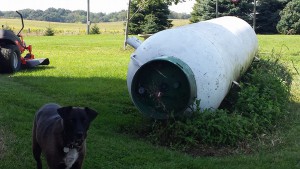
Last Friday, if you’ll remember, was a gorgeous day, and since I had no transportation, it was perfect for catching up on laundry and mowing the lawn. My plan was to quickly mow around the clothes line and lp tank which was nearby, hang a couple of loads of on the line and then proceed with mowing.

Our 1,000 gallon lp tank had been listing terribly and literally mere moments before jumping on the mower, I’d been looking at it, its left side sinking into the ground, knowing it needed to be moved.

Well . . . it got moved alright.

As I was mowing around it, the back tire of the lawn mower may have made contact with the tank. If it did, it was a light nudge, hardly a push, in fact, it was likely the wind, but whatever it was, as I drove my new mower away from it, I caught movement out of the corner of my eye. The tank was rolling after me.

It sounds horrible, but it only rolled forward a foot or two, the line didn’t disconnect and all was well. (My lack of luck? Maybe I’m luckier than I thought because several people said it could’ve easily resulted in an explosion. Yikes!)

As it turned out, Eastern Iowa Propane was able to move it to a different spot and all is well.

Except one final “grrr” happened before my bad luck streak would be complete.

While a writer really only needs pen and paper, in today’s world, computers are vital. Mine seized Sunday as I was working on a project and stayed frozen until Wednesday when I was able to get it to a tech person. Of course it started right up for them! The techies claimed it was a glitch in one of my programs, but it solidified the disdain I have for my dependence on technology!!! (And my belief that computers have personalities and that mine is a passive-aggressive jerk.)

That said . . .

My son is again chasing soccer balls,

My car is purring like a kitten.

My fuel tank is sitting solidly safe

And my computer isn’t giving me fit(ten)s.

I sure hope these days of bad luck are done,

That blue skies and happy faces return.

But I guess it helps to count my blessings

And consider this week a lesson learned. . .


Originally published 27 Sept 2014 in The Observer.

From ‘The Giver’ to ‘The Roosevelts,’ HOPE


I can’t remember which book I read first, Lois Lowry’s “The Giver” or Barbara Kingsolver’s “The Handmaid’s Tale.” It was only a couple of years ago, but what I do remember is feeling hopeless.

If that was how those books made me feel, why read more? Admittedly, I can be a little dense and it would take several more brushes with dystopian literature before I’d grasp the meaning of such a category.

There was the buzz over “The Hunger Games” trilogy by Suzanne Collins. With the first movie set for release in 2012, I read all three before. Then there was Veronica Roth’s “Divergent” series.

Fortunately my mom, aunts and cousins formed a book club before I could read Roth, thus steering me away from such bummer reads. That, and the ridiculously addictive “50 Shades” was released that same year.

But eventually I found myself back in the future, watching the big screen version of Orson Scott Card’s “Ender’s Game” and reading Edan Lepucki’s “California” this summer.

As mentioned, I can be a little simple and while I’d heard the word “dystopian” thrown about, it didn’t dawn on me that this was the category of literature I’d been consuming until this summer when muscling through Lepucki’s debut tome about life after the collapse of the U.S. government.

My husband asked me what it meant, dystopian literature. I said, “Think the opposite of ‘utopia.’”

I’m not sure what came first, my current episode of depression or reading this depressing genre, but they certainly haven’t helped one another.

I guess I shouldn’t have been surprised when a close friend recently asked me to stop reading dystopian literature, “at least for the rest of the year.”

She should’ve included movies in that plea as my daughter and I saw “The Giver” over the weekend.

I’ve heard some fans of the book argue the movie did not follow the story as much as they’d hoped. Myself, I didn’t like the movie (or the book) because it’s so dang depressing!

My critics would argue all these books and movies end on hope-full notes, that the characters realize the err in such a life and seek change for the better. I, however, get snagged on the society those characters are pushing against—how did it get that way?!

With “The Giver,” life has been sterilized against all emotion, all choice in exchange for an easily controlled, peaceful society. Daily medication is administered to everyone in an effort to keep the senses dulled and the mind clouded.

But when the lead character, Jonas, nears graduation, he begins to glimpse moments of color. At graduation, when teens are assigned their careers, Jonas learns he’s going to be trained as a “Receiver” and in meeting with the “Giver” (played by Jeff Bridges) Jonas starts to question everything.

As memories of the human race are transmitted from the Giver to the Receiver, Jonas begins to understand society has been robbed of all the freedoms that make us human—freedom to feel, freedom to see, freedom to sense.

The book version ends with Lowry leaving the reader to decide what happens to Jonas. The movie chooses a more definitive, happier ending. Both endings left me sad.

How does a society implode in such a way that results in having all choice removed?!

I’d like to imagine we’re far from such a dystopia, but we’re not. Look at the state of our nation.

Our government doesn’t work. Our nation remains hung up on skin color and gender. Our Supreme Court ruled money talks. Our middle class is dying from stagnant wages, rising costs and an unfair tax code. Our manufacturing was exported. Our jobs were out-sourced. And the only people benefitting from America’s current way of life is our elite class, the 1 percenters.

To me, it feels as if our country is barreling towards an abyss from which we’ll never recover, so thick is the hatred and greed.

But then came Ken Burns. This amazing film maker has released yet another series, the seven-day “The Roosevelts: An Intimate History” on public television, which concludes tonight.

I find hope in Burns refusing to let history be forgotten, in his innate ability to show people the similarities between their then and our now.

With “The Roosevelts,” Burns is able to show how important it is for government to intercede when the “ruling class” refuses.

From this early 20th century era, our country saw positive change come to the working poor with improvements made in wages, working conditions and hours. Women gained the right to vote. Monopolies and trusts were destroyed.

What happened? Several decades of “can-do” Americanism, though some will try to argue this impetus.

I take heart in knowing others have been watching “The Roosevelts” and will acknowledge its parallels to today’s weakened America. My hope is still others will begin to recognize the lies some media are selling them, will grasp the necessity for helping the less fortunate, will see that 99 percent of us are held hostage by the ruling class.

My main hope, however, is that people will open their eyes and ears and hearts to understand that the society in which we live is broken. But, most importantly, that we can do better and thus avoid a dystopian reality.


Originally published 20 September 2014 in The Observer.

Adventures in lawn care & life north of Hwy 136


Just so you know, I kind of love mowing lawn. It harkens back to those pre-teen years when cousin Laura (Olson) Wallace and I would spend hours and HOURS grooming Gramma Olson’s expansive front lawn, orchard and sprawling east yard that doubled as a baseball field.

More than a job or task to sweat through, mowing Gramma’s grass offered a sense of pride. The clean lines. The level grass. The smooth results. Could there be a more visual example of the term: perfect?

Like a spotless kitchen, a clothesline filled with laundry or a re-organized desk, the feeling of order—albeit brief—is one of the best feelings I know!

And it’s in the grass, a perfectly coiffed lawn, where I find my greater peace . . . or at least I did.

For the first chunk of Marty and my marriage, we were “townies” living in DeWitt, Iowa, and the mowing of our corner lot was his domain. I was used to caring for big spaces with big lawns, not small, fenced-in plots of grass.

A phrase like “clipping the lawn” sounds cute and suggests a job that requires minutes, which is how long it took Marty when we lived in town. A cool 45-minutes of sauntering behind a push mower and that was that.

So when we left town and took over the old Joe Brown place, I was stoked at the idea of having a big lawn. What I wasn’t prepared for was how unruly that lawn would be!

Initially I envisioned using our push mower on the three mow’able acres that made up our four acre parcel. I saw my legs getting buff, my arms, toned, but then reality hit me. We needed a riding lawnmower and went with what we could afford, a hand-me-down freebee from Dad Reed.

That old John Deere lasted a few passes before chugging to its death, mid-job. It didn’t even make it to the end of the season. And because we lacked the necessary moving equipment, the poor thing sat in our front yard for a couple of weeks while grass grew up around it.

If Joe Brown’s spirit still hangs about our farmette, I’d like to think he and his late wife Marge find our efforts to tame their wild land humorous. I’d hate to think he’s put a curse on us.

But when you consider our history with lawnmowers, it’s hard to think otherwise. Joe Brown’s has shown to have the exemplary talent for weed growth and lawnmower extermination.

To date, Joe Brown’s has killed not one, but TWO old John Deere mowers, our once-new push mower as well as a new Poulan. And our current used Sears Craftsman looks as if it won a lawnmower demolition derby (and mows like it, too).

The serenity I used to find in mowing my parents’ and grandmother’s yards has yet to be found at Casa Reed Murrell. Who knew you could actually take smooth ground for granted, but you can. I did. Having grown up along Hwy. 30, between Calamus and Grand Mound, the ground is flat and the lawns have a near fairway-like quality.

After nine years of working to make Joe Brown’s ground behave, fighting with it to smooth itself out, Joe Brown’s ghost has been laughing his tail off.

The early years were fraught with spring thaws that would have the lawn heaving various forms of detritus: glass and bricks, car door handles and lug nuts, batteries and hub caps. The first mows of the season were very much like Forrest Gump’s box of chocolates.

You’d think I’d get used to the loud bang that results from running the mower over these objects, but when the blades find an old wrench and send it banging around the undercarriage and out the side, that’s a sound (and feeling) from which you don’t quickly recover.

And then there were the imaginations of our children when at ages three and six, Maclane and Moira, would take large rocks and make “dinosaur nests.” The kids, especially Maclane, were huge into dinosaurs and one day they hatched the brilliant idea of pretending the decorative river rock around the house were dinosaur eggs. They’d take these rock “eggs” and build nests throughout the yard. Sometimes at the base of trees, other times, out in the middle, blanketed by grass “so they’d stay warm.”

Imagine, bouncing along (there’s no smooth rolling), focusing on how grateful you are that the machine was actually working, only to have one’s reverie harshly interrupted by the horrific sound of large river rock being chewed up by your already-ailing lawnmower?

Nope. Not fun.

Along with this, let’s not forget the oodles of trees Marty’s planted every year. Adding to the handful of young firs already established, he’s added countless variety of trees and bushes. Between the trees already here, the stumps of trees lost and the ones Marty and the kids planted, we have exactly 95 trees (and two stumps) around which we now mow.

It’s a job requiring much patience, many hours and lots of “Marty” since he’s the only one who can get the Craftsman mower to start.

Just as I’d begun to think I would never again experience the Zen-like satisfaction of a day’s worth of lawn work, I went and got myself an early birthday present!

For the last year I’ve been sniffing around for a new (or newer) mower. But it couldn’t be just some ordinary rider, Joe Brown’s was proving to be a wily foe. It was time we got serious and until recently, it was an expense I simply couldn’t justify.

The Pat Howell quote: “Grass is the cheapest plant to install and the most expensive to maintain,” couldn’t be more true.

Tune in next week for adventures in zero-turn mowing . . .


Originally published 6 September 2014 in The Observer.

Lady Justice descends on serial-killer lawn


So I love mowing lawn, right? Well, I did . . . back in the day, when still a minor living at home.

The smooth, evenly cut grass of my Gramma Olson’s big yard was a thing to behold. Sure my lines could get a little crooked, especially when ground squirrels whizzed by, diving for their burrow right in front of my mower. But her lawn was flat, the grass was smooth and all felt right with the world.

I thought every lawn was like this. How naïve.

Tnew mowerhe nearly three acres that make up the mow’able portion of our Joe Brown farmette are anything but flat. And smooth? Hardly. Though fitting, given Joe Brown’s used to be a horse ranch, I didn’t think it possible to get saddle sores from mowing. You can.

Our “lawn” is made up of several areas: the front yard, the back yard, the yard in front of the corn crib and the yard behind the corn crib. I’d estimate the only flat, smooth portion is a 10-foot by 40-foot plot northwest of the house. The rest is a mine field.

Hindsight being what it is, I shouldn’t be surprised the four ordinary lawn mowers we’ve operated over the last nine summers would simply falter when faced with the monumental task of taming the beast that is the Joe Brown yard.

I never knew Joe Brown, but am often regaled with wild tales of goats in the bath tub, horse kibble in the kitchen, engines in the dining room and assorted saddles and bits in the living room. I never tire of hearing how nutty and open-hearted he was, but shaping up the Joe Brown place is no small feat.

It was clear, as Marty endlessly toiled to sustain the life of our fourth mower, a used, beat-up Sears Craftsman, we could no longer get by with a common, ordinary machine.

And given Marty’s work schedule coupled with his involvement at the Rock Creek Eco Center, not to mention managing the Charlotte Little League and coaching both baseball and soccer, he was eager to rid himself of the chronic pain that is the maintenance of the Joe Brown yard.

Which leaves me . . . and my lack of education in the industrial arts.

For a year I’ve been nosing around at local dealers, perusing the Internet, eye-balling sale ads and basically looking for something to smack me alongside the head.

Not only did I have my brother, Matt Reed, on the hunt, but Mom and Dad Olson, as well. The hunt was fruitless or maybe I was just gutless, how could I not be?! Our Joe Brown yard had killed three mowers and the fourth was dying a slow, hard-to-watch death. This yard was a serial killer!

Depending on whether it was Marty or I doing the mowing, the job could take anywhere from four to six hours. After, of course, the battery sat on a charger for a couple of hours. And the result of all that labor? A crappy looking lawn.

By Labor Day weekend, after wasting Friday fighting to get the dang thing started and burdening Marty with the task after he got home from work, I snapped. We were either going to fork over the cash for an appropriate mower or buy a herd of goats.

With Dad Olson available to “window shop,” he and I went to G & H Mowers in Grand Mound, Iowa, where he showed me what he’d wanted to buy last spring before Mom went and bought a new house.

I can’t help but feel like Tim ‘The Tool Man’ Taylor when I speak of this beast: a 48” Simplicity Champion XT commercial zero-turn riding lawnmower. Arw arw arw!!!

G & H co-owner Dennis Galloway reviewed the specs, told me about the four-year warranty and what they offered for maintenance. I figured if it was good enough for Dad, it was good enough for us and by Tuesday afternoon they’d delivered it and schooled me on the wily ways of zero-turn mowing.

First, I’ve never felt like a bigger idiot than when making the first passes around the front lawn. It was an all hands, no feet operation. To move ahead, you pushed the hand levers forward. To slow down, you pulled them back. There was no cruise control and no foot break. When I went forward it was either like a snail or a rocket. Clearly this took more finesse than I expected. And straight line? How ‘bout squiggles?

The turning was pretty awesome, but the looking out for low-lying tree limbs was another thing. The Champion XT came with a roll bar that Dennis warned we would likely remove if we had a lot of trees. (Remember, we have 95. NINETY FIVE!)

After snapping a couple of limbs and almost getting thrown off by one particularly strong branch, I parked it and let Marty remove the bar.

I’ve since mowed one other time and I’m quite smitten with the machine. Our grass looks level, the mounds of hay-like clippings are decreasing and the time? The first mowing took 3.3 hours and the second, 2.9!

I think this is the beginning of a beautiful relationship.


Originally published 13 September 2014 in The Observer.

Where did it go? A summer recap


Where did summer go?

One minute I’m swatting away pesky gnats while watching my son play baseball, and the next I’m dodging lightning bolts while timing participants of last Saturday’s CharVegas Mud, Sweat & Tears obstacle race.

Where did summer go?!!!

mac at deep creek dashI didn’t think we were over-scheduled. Daughter Moira doesn’t play softball and I kept my races to a five-year low. And yet here we are, Labor Day Weekend, and I’m wondering where the last three months went.

I remember being 5-years-old and sitting outside with my mom. It must’ve been a late August afternoon when I said to her, “Summer went fast.” I remember it so vividly because it was one of the few times Mom agreed with me, adding, “They go quicker every year.”

From ‘hospital corners’ to hanging laundry, my mom has dealt us her share of “pearls” but this was one that’s stayed with me because she couldn’t have been more right. In the nearly 40 summers since she said that, it’s unbelievable how each year the months of June, July and August fly by with increasing speed.

Where did June go?

We planned for this month to be low-key given the oral bone graft surgery daughter Moira had in mid-May. We were prepared for six weeks of slow, but the surgery went so well with bone being harvested from the mouth vs. the hip, that it hardly caused a hitch in her giddy up.

While she wouldn’t be cleared to eat hard foods until late June or go biking or swimming until August, her tan legs are proof of the hours she spent peacefully swaying on a porch swing that her brother and I built and attached to the frame of their old swing set.

I think of those days and forget about the flurry that was June. Son Maclane’s baseball schedule and Marty’s second year as general manager of the Charlotte Little League made it feel like the Charlotte ball diamond was a second home.

More than once did I laud friends who had multiple children on multiple teams, doffing my cap at their seemingly relaxed ability to catch each game and hardly break a sweat. I could barely squeeze in a game or two of nephews Jacob and Nic Reemstma.

But June was more than post-op recovery and baseball, it was also when my parents left the homestead and moved into DeWitt, when I stepped up to the direct the annual Paul Skeffington Memorial Race while also training for my first QC sprint triathlon.

Mom and Dad’s move was arduous in both physical and emotional ways while the Skeff Race and QC Tri were intimidating learning experiences. Fortunately I had wonderful committee members willing to hold my hand and fabulous training partners who coached me along.

And then suddenly it was Independence Day.

Where did July go?

The 4th always hits me with a dose of melancholy as it seems to herald summer’s swan song. And given Mom and Dad’s move “to town,” our annual watching of the Grand Mound fireworks from their house was now a thing of the past. All of us let the holiday go without much fanfare.

Just when we was ready to breathe a relaxed sigh that baseball was over, we realized the county fair was mere weeks away and neither child had started their fair projects. Any post-baseball bliss was kicked away by oodles of stripping, painting, sanding and varnishing.

Add to this Marty’s brief visit to New Orleans for a work conference, my participation in a 70.3 Ironman, a running of the Bix and the four of us at a Chicago Cubs game, and our cats were the only ones enjoying any sort of downtime.

And then we were driving to Wisconsin!

Where did August go?

During the first week of August, we took ourselves off the grid (well, ok, there was wifi) for a week along the shores of Moose Lake in Wisconsin’s Northwoods.

We swam, I biked, we boated, they fished. I taught Maclane how to play Gin Rummy while Marty and Moira shared secrets around the campfire. We listened to the Loons, hoped to spot the otters and bears, but mostly did a lot of nothing. It was heavenly.

And then we came back and went immediately to the State Fair, and then Northeast and Central school districts started school, and then I headed off to participate on a 6-person Ragnar Great River relay covering 200 miles in 36 hours. I’d done it before, but the heat got to me and all I can say is I survived and we weren’t last.

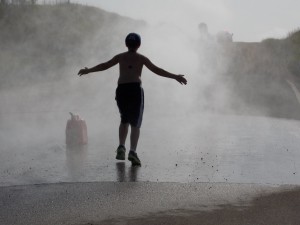
And then there was last weekend’s Charlotte Days with the first CharVegas Mud, Sweat & Tears obstacle race, which Maclane and buddy Isaac Trenkamp (and his mom, Patti) all completed during Saturday morning’s booming thunderstorm. While the storms put a damper on the crowds, the clouds cleared for Sunday’s 3rd annual Deep Creek Dash squirt gun 5k that will fund scholarships for local would-be Little Leaguers in the 2015 season.

What a fitting cap to such a busy summer! Despite the storms on Saturday, the drenched and dirty participants were all smiles. And though our 5k race is small, hovering around 40 runners and walkers, this year had a “golly gee Beave” sort of joy to it.

I may be tired, but it certainly was a great summer.


Originally published 30 August 2014 in The Observer.